A strategic perspective on seamless IoT network transition
Transiting from small to large scale deployments, a LoRaWAN Network Server Migration can be the best move.
The Internet of Things has matured. What once began as small-scale experiments has evolved into mission-critical infrastructure connecting millions of devices. Yet, many organizations today still rely on early-generation network servers or open-source systems that can no longer keep pace with their growth.
Scaling up an IoT network often exposes hidden limits: missing features, complex configurations, or inconsistent reliability. At the same time, service quality, pricing models, and security requirements are changing faster than ever. The result is clear — more and more operators are facing a decisive moment: continue maintaining a fragile system, or evolve to a smarter, enterprise-grade solution.
Why organizations migrate
Every migration begins with a realization: the current system no longer fits the organization’s needs. For some, it’s about missing capabilities — advanced analytics, multi-tenant management, or seamless API integrations that their existing platform cannot provide. Others are motivated by poor service quality: unreliable uptime, slow response times, or poor customer support that directly impact end-user experience.
Another common driver is cost and commercial change. Licensing or infrastructure costs can quickly escalate as networks expand, especially for organizations running self-hosted or open-source platforms. What began as a cost-effective prototype becomes expensive and time-consuming to maintain.
Self-managed solutions also reach a technical ceiling. While open-source LoRaWAN® servers such as community editions are excellent starting points, they are rarely engineered for enterprise-scale deployments. After months of operation, teams often find themselves struggling Network to handle upgrades, scaling, and device management efficiently.
Other setups suffer from over-engineering — complex on-premise systems that demand significant operational expertise. Managing such infrastructure can become an obstacle to innovation rather than an enabler.
Security adds another layer of concern. Public infrastructures may not offer the isolation, data privacy, or compliance assurance that regulated industries require. Enterprises are increasingly seeking private or dedicated SaaS environments where they control access and compliance policies.
In short, migrations are driven by a combination of technical, operational, and strategic motivations — from the need for reliability and scalability to the pursuit of better service, transparency, and trust.
What migration really involves
Migrating to a new LoRaWAN Network Server is never just about moving data — it’s about managing change, complexity, and sometimes a bit of chaos. As every Head of Operations or Network Engineer knows, even the word 'migration' can cause a brief flash of anxiety: downtime, organization, configuration files, who moved my API key? And that’s perfectly normal.
At LORIOT, we’ve seen every variation of migration — from small pilot networks to nationwide infrastructures — and we know that what looks like a simple ‘lift and shift’ on paper usually involves a lot of coordination, testing, and reassurance. That’s why empathy is part of our process: we plan migrations with the same care we would if our own network were at stake.
A successful migration isn’t only about transferring devices; it’s about keeping your team confident, your operations running, and your customers unaffected. To achieve that, we focus on clarity and structure — making sure each part of your ecosystem transitions smoothly.
End devices come first. Each one must retain its credentials, activation method (OTAA or ABP), and configuration profile. Then there are gateways, the silent workhorses of your network, often requiring remote access or field adjustments to point them toward the new server.
So yes, migration might sound daunting — but with a plan, the right tools, and people who’ve done it many times before, it’s not chaos. It’s simply evolution, handled with precision (and just a bit of humor to keep things running smoothly).
How to migrate successfully
Let’s be honest: 'migration' rarely makes anyone smile. When teams hear it, they immediately picture late-night cutovers, gateway configs gone missing, and the one spreadsheet that holds everything. We’ve been there — which is exactly why our process focuses on keeping things predictable, transparent, and calm.
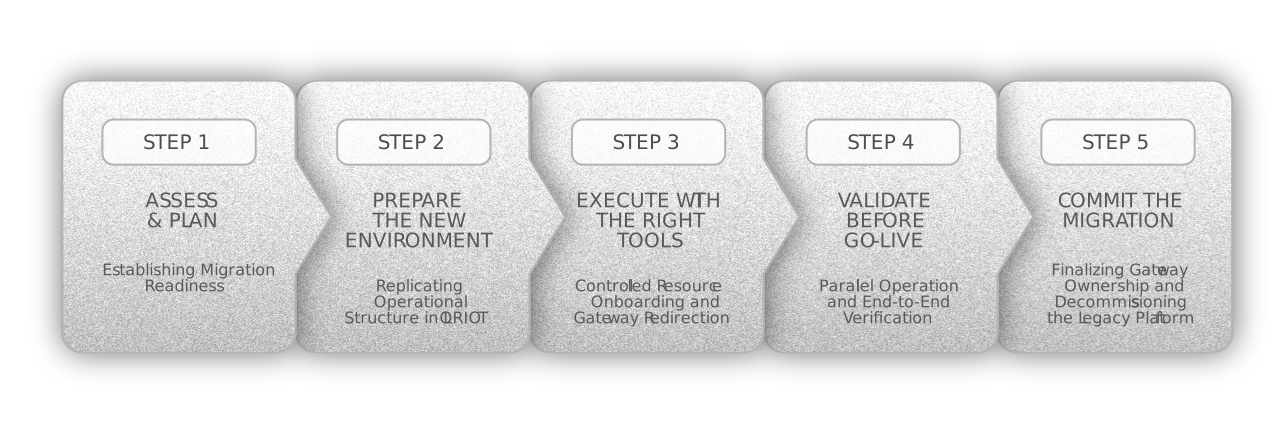
A successful migration is 80% preparation and 20% execution. The goal isn’t just to move data; it’s to make sure you sleep well the night before go-live.
Assess and Plan — map what you have and define what success looks like.
Prepare the New Environment — replicate your structure in LORIOT’s workspace.
Execute with the Right Tools — use the LORIOT Migration Tool to handle the heavy lifting.
Validate Before Go-Live — run both systems in parallel and confirm all outputs.
Commit the migration — traffic moves, gateways connect, and data flows smoothly.
Migration doesn’t have to be dramatic. When done right, it’s a controlled evolution — and you come out stronger, cleaner, and more scalable than before.
“The migration from our previous provider to LORIOT was incredibly easy. The team at LORIOT had everything well prepared, guided us through every step and made the whole process feel seamless. The support and planning was excellent and made for a smooth migration.” Christoph Gattinger, BellEquip
Benefits — Why it’s worth it
After every successful migration, there’s a moment when teams realize they’re not just on a new system — they’re finally free from the friction that held them back.
Scalability without headaches — LORIOT’s architecture scales effortlessly.
Simplified operations — managed, monitored, and secure.
Security and peace of mind — full control in your chosen environment.
Transparent partnership — clear terms, no surprises.
Continuous innovation — new features and integrations that keep your network future-proof.
Conclusion — From migration to evolution
Migrating isn’t just a technical step; it’s a strategic decision to invest in stability, scalability, and trust. We know it takes courage — and a bit of patience — to move critical infrastructure. But with a solid plan, the right tools, and a partner who’s done this before, it becomes less of a leap and more of a walk forward.
At LORIOT, we’ve guided organizations of every size through that process. We know the challenges, we anticipate the surprises, and we genuinely care about making it feel effortless. Because for us, migration isn’t just about moving systems — it’s about helping you grow without limits.
Your advantages with LORIOT
Tailored assessment of your current infrastructure and migration readiness
Comprehensive migration concept including cost, effort, and risk evaluation
End-to-end migration implementation and performance validation
Proven expertise in large-scale IoT network transitions and enterprise deployments
Trusted by global operators and solution providers across public and private sectors