"A transactional team fixes the break. An excellent one explains why it happened."
Technical support is usually described in numbers: response times, ticket volume, time to resolution. None of those numbers say much about what actually happens between an engineer and a client during a difficult week.
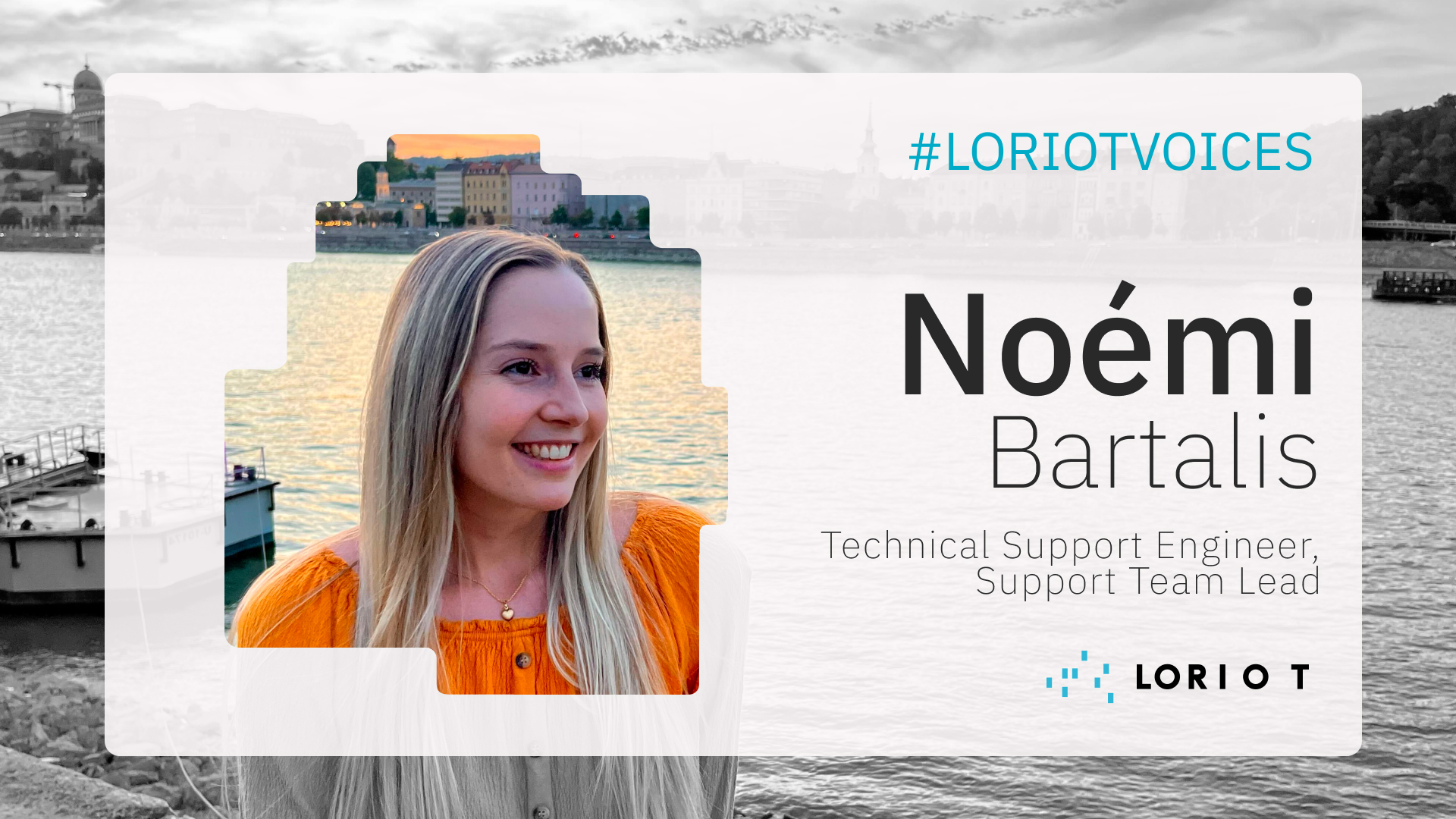
Noémi Bartalis leads LORIOT's Support Team as a Technical Support Engineer and Support Team Lead. She describes her engineers as technical detectives working inside the LoRaWAN ecosystem, and she's built the team around a simple conviction: careful, educational work beats fast closure. That means measuring satisfaction and resolution depth instead of throughput, protecting the team from burnout under pressure, and creating an environment where asking for help carries no cost.
In this edition of #LORIOTVoices, Noémi talks about building client confidence when there's nothing to report yet, translating system logs into business impact, what female leadership contributes to a highly analytical team, and why watching a colleague solve something alone is the reward she values most.
1. You lead LORIOT's Support Team. What does that mean in practice, and what does your team deal with on a daily basis?
Leading the Support Team at LORIOT means balancing deep technical investigation with human empathy.
On a daily basis, my team does not deal with standard, straightforward IT issues like simple password resets or basic software glitches. Instead, they act as high-level technical detectives within the very complex LoRaWAN ecosystem. A single customer inquiry might require us to analyze unusual device behavior, investigate gateway connectivity drops, decode complex data payloads, and ensure smooth cloud integrations through our network server.
Because the technical demands are so high, leading this team in practice means acting as a dedicated problem-solver and a bridge between our Support Engineers and Product & Engineering departments. A big part of my day involves managing tasks and resources to ensure the team has the mental space, the technical documentation, and the emotional support they need to solve complex puzzles.
I have to actively monitor their workload to prevent burnout under high pressure, ensuring they can focus completely on delivering the high-quality solutions our clients rely on to run their operations.
2. IoT support is not always a quick fix. How do you keep clients informed and confident throughout a complex resolution process?
"Trust is often built during the waiting time, and in the deep-tech space, resolving an issue is rarely instant."
Investigating random gateway disconnects, tracing packet loss across complex network architectures, or debugging API integrations between our Network Server and a client's application takes significant time and careful analysis. To keep clients confident during these longer periods, we operate on the fundamental rule that we must communicate with the client even when there is absolutely no technical update to share. A simple message letting them know that our engineering team is currently running tests and that we will provide another update as soon as we have more clarity changes the dynamic from a routine service-ticket transaction into a true collaborative partnership.
Furthermore, we recognize that our clients are running real-world businesses, so we never just hand over raw system logs and expect them to figure out the problem. We actively translate complex technical realities into business impacts, helping clients understand exactly how a resolution timeline affects their operational deployments so they can adjust their plans and maintain their own continuity without unnecessary anxiety.
3. What is your idea of excellent support, and how do you translate that into how you lead your team?
My idea of excellent support is that it should build relationships, educate the client, and give them confidence, rather than just being a quick transaction.
"A purely transactional support team simply fixes the immediate break and moves on, whereas an excellent support team takes the time to explain why the break happened and how the client can optimize their network to prevent it from occurring in the future."
I bring this idea into my leadership by changing how we measure success and performance within the team.
I actively encourage my team to invest the extra time needed to write a thorough, highly educational response that genuinely empowers the client to understand their own infrastructure better. To support this, I prioritize quality-driven metrics like Customer Satisfaction scores and the depth of the technical resolution over purely quantitative, high-pressure metrics like sheer ticket volume or rapid response times.
I prefer the team to feel rewarded for being careful, thoughtful consultants rather than feel pressured to act as ticket-closing machines.
4. Support is the area closest to the client. What does that proximity tell you about the impact of LORIOT's solutions?
Because our Support Team is the area closest to the client, we act as the ultimate real-time feedback loop and the true voice of the customer.
This proximity gives us the special chance to see LORIOT's technology taken off the conceptual whiteboard and put to work in the wild.
We do not just look at data packets and server uptime; we see a stable network directly powering critical smart city infrastructure, optimizing crucial water usage in large-scale agriculture, and tracking global logistics.
Because we are on the front lines every day, we hear the daily pain points, the creative workarounds clients develop, and the future wish lists of our users.
One of my most important strategic duties is passing this direct feedback to our Product and Engineering departments. By doing this, we ensure that our development roadmap is not just driven by technical goals, but is truly based on the real-world needs and challenges of the people using our technology to run their businesses.
5. What do you think female leadership brings to a technical team like yours?
Technical environments are naturally highly analytical, heavily driven by logic, complex code, and hard performance metrics. Deep engineering skills, like understanding complex network protocols, advanced debugging, and system architecture, are the absolute foundation of what our Technical Support Engineers do every single day.
However, while those high technical skills are mandatory, I believe female leadership often brings a strong, helpful focus on emotional intelligence, empathy, and active listening. These qualities do not replace hard technical skills; instead, they make them stronger. They are critical not only for calming down frustrated clients during network issues but also for building a supportive environment within our team.
"I want my team to feel completely safe dropping their egos, asking for help, and admitting when they are genuinely stuck on a problem without any fear of judgment."
When a highly skilled technical team can work together openly and honestly, that is when the most brilliant, out-of-the-box troubleshooting actually happens.
6. What is the most rewarding part of this work?
For me, the most rewarding part of this work is an equal tie between helping clients succeed and watching the people on my team grow.
On the client side, it is incredibly fulfilling to take someone who is highly stressed by a complex technical issue and guide them step-by-step to a moment of complete resolution and technical understanding. Turning a frustrated user into a confident, educated fan of our platform is a wonderful feeling.
On the internal side, the best reward is working closely with the team and watching them evolve over time.
"Seeing a colleague who initially needed guidance on certain issues confidently and independently solve a deeply complex problem is the ultimate win."
Support is where technology stops being a diagram and starts being someone's Tuesday morning. Noémi's approach reflects something we care about across LORIOT: solving the immediate problem, then making sure the client understands their own infrastructure well enough that the problem doesn't come back.
If you're running networks at scale, we'd like to hear where the friction actually sits for you. Leave it in the comments, or come tell us in person at IoT Sparks ✨ this October at the Palau de les Arts in Valencia, where you'll be able to meet the whole Support Team: Noémi Bartalis, Attila Mátyás Balogh, Ádám Juhász and Károly Sárdi. They're the people behind your tickets, and a good part of what has shipped in the LORIOT NMS started as something they brought back from a conversation with a client.