Jump to content

Tourist Flow

LORIOT Verso Tourist Flow

Tourist Flow

Anticipate crowds before they form. Our IoT solution combines real-time people counting with predictive analytics to keep busy tourist destinations safe, fluid and enjoyable.

Popular destinations live from their visitors, but the same crowds that bring economic life to a city can quickly overwhelm its streets, squares and landmarks. Traditionally, crowd management has been reactive: staff are deployed, streets are closed or traffic is diverted only once congestion is already visible. This affects residents, frustrates visitors and puts pressure on local services.

Our People Flow Tracking solution shifts this approach from reaction to anticipation. By connecting new and existing sensors through a secure data pipeline and analyzing live and historical movement patterns, we give city staff a clear picture of what is happening now and what is likely to happen next, so they can act before bottlenecks occur.

Benefits


Proactive crowd management

Proactive Crowd
Management

Our prediction engine forecasts where and when overcrowding is likely to happen. Municipal teams can redirect flows, adjust staffing or inform visitors in advance, instead of responding once an area is already saturated.


Safer public spaces

Safer Public
Spaces

The system flags specific events in real time, such as sudden crowd build-ups, disturbances or bicycles in pedestrian zones. Alerts reach the right people at the right time, helping prevent minor incidents from escalating.



Unified city data

Unified
City Data

Cities already operate many sensors and databases. Our solution brings legacy and new data sources together in one standardized format, turning scattered information into a single, reliable basis for decision-making that connects easily with current and future city management systems.

How it works?

  1. SENSORS & SMART CAMERAS

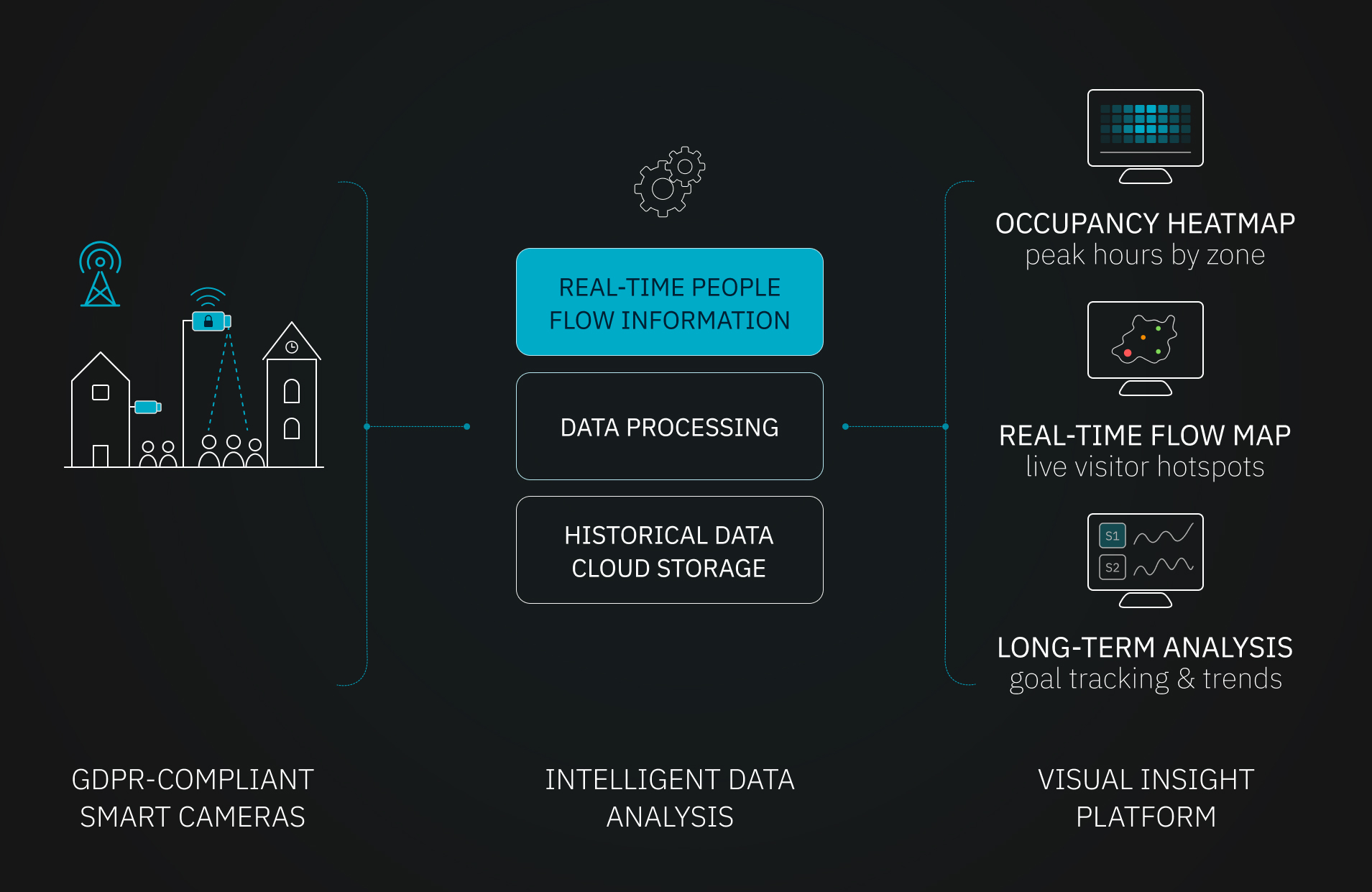
    Sensors and GDPR-conform cameras are strategically placed in areas prone to heavy crowds, such as historic centers, transport hubs, beach promenades or major attractions. They count people, detect the direction of foot traffic and identify relevant events like sudden crowd formation, disturbances or bicycles in pedestrian-only areas.
  2. SECURE DATA PIPELINE

    A central integration layer acts as a secure bridge between all data sources. It ingests raw data from both new devices and the city’s existing sensors and databases, converts it into a standardized format and forwards it to whichever systems need it. This protects previous investments and avoids creating yet another isolated data silo.
  3. PREDICTION & VISUALIZATION

    Our prediction engine analyzes the live data stream. By identifying recurring patterns, such as weekdays, seasons, or events, it forecasts upcoming congestion in advance.

    The results are displayed in an independent, intuitive dashboard showing live conditions, flow trends and anticipated bottlenecks. Custom alerts notify city staff when thresholds are expected to be exceeded, and the data can be shared with existing or future Smart City platforms, public information panels or visitor apps.
Tourist Flow Infrastructure Graphic: sensors and cameras, secure data pipeline, prediction engine, dashboard and integrations


Book a Free Call
  • Robin Wulfes

    Robin Wulfes

    IoT Solutions Lead,
    LORIOT Verso


    “What makes this solution really unique is that it doesn’t ask cities to start from scratch: it connects the sensors and data they already have with new technology, turning fragmented information into clear, predictive insights. The result is safer streets, a better experience for visitors and a better quality of life for residents. For us, this is exactly what IoT should do: create real, measurable value for the people who live in and visit our cities.”

FAQ


  • Does the system identify individuals or store personal data?
    No. The solution is designed to measure flows, not people. Camera footage is processed directly on the device (edge processing) and converted into anonymous counts and movement data. No images, faces or personal information are stored or transmitted, ensuring full compliance with GDPR and privacy regulations.
  • Can the solution work with the sensors and databases our city already has?
    Yes. This is one of its core strengths. The data pipeline is built to ingest information from legacy systems as well as new devices, standardize it and pass it on to other platforms. Existing infrastructure is reused rather than replaced.
  • Who owns the data?
    The city. Data is a public asset, and our system is designed so that data control and urban analytics always remain with the municipality.
  • How can I estimate the number of sensors needed?
    Every project is different. The number of devices depends on the size of the area, its layout and the number of access points and hotspots to be monitored. Sensors are placed at strategic locations to cover as much of the relevant area as possible at the lowest cost.
  • Can the solution be integrated with existing city management systems?
    Yes, integration with Smart City platforms, traffic management systems, public displays or tourism apps is no problem and can be adapted to your needs.
  • How much does the solution cost?
    The solution is adaptable to various budgets and project sizes. A pilot in a single square is just as possible as a city-wide rollout. Pricing varies accordingly.
  • How does the technology behind the solution work?
    If you want to learn more about the technological aspects of our solutions, please read here.


Interested in keeping your city’s streets fluid and welcoming, even at peak season?


Let’s discuss how we can tailor this innovative people flow tracking system to your specific project.